
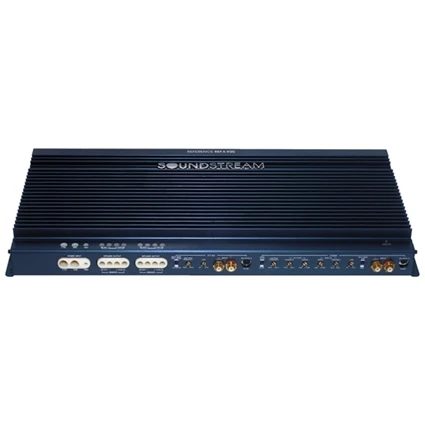

Soundstream – REF1.500
Ursprünglicher Preis war: 337,00 €96,99 €Aktueller Preis ist: 96,99 €.
- Kaufen Sie Qualität, kaufen Sie bei uns.
- Einfache, schnelle Rückgabegarantie
- Kostenloser Versand, Qualitätsware
- Risikofreies Einkaufen mit Retouren

It has been over a decade since the Reference amplifiers graced the car industry. Car audio veterans loved them. New-schoolers have dreamed about them. Only the privileged have heard them!
Improving on the best of anything requires new technologies and new applications. We are immensely proud to re-introduce you to the new Reference amplifiers. Not “dream” amplifiers that will never be seen, but a full line of the finest amplifiers that are available now!
Reference amplifiers boast damping factors over 1000 and up to 3000+. That is up to, or more than 10 times, that of normal amplifiers! There has been a theory for many years that says that the human ear cannot hear the difference between amplifiers. Anybody who believes this obviously hasn’t auditioned the long awaited return
of the Reference amplifiers!
Sometimes the best things are worth waiting for…
FEATURES
In the 80s, it became popular to use acronyms for amplifier features and technologies. In some cases, these acronyms were nothing more than fancy words put together cleverly to form an acronym not worth its weight in poop! Sales people memorized the silly acronyms but rarely knew what the feature encompassed. The features below are straight forward facts about the amplifiers that make them yield audio nirvana.
General:
- Sequenced Delays Eliminate Residual Power-Up/Power-Down Pops
- Differential RCA Inputs Isolate 12V/Audio to Ground, Eliminating Ground Loops and Noise
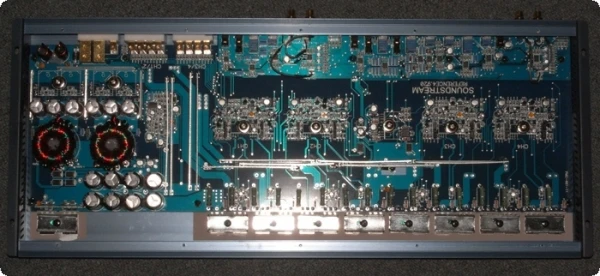
- Full Signal Path Low Noise/Distortion Circuitry Topology
- Optimal Component Layout for Minimal Distortion Induction & Signal Separation
- Triple Darlington Audio Output Stages
- Differential Drives Divide Pre-Amp & Power-Amp Stages, Eliminating Ground Looping
- Full Differential Feedback Surrounding Power-Amp Stages directly from Speaker Terminals resulting in Uncolored Sound Reproduction and Elimination of Ground Loops
- Output Stage Bias Individually Sequenced, Optimizing Sound Quality
- Stout 2 Oz. Copper Traces Effortlessly Transfer High Volume Internal Current
- Close Tolerance Signal Path Components – 1% Resistors & 5% Capacitors
- Final PCB Layout Designs are culmination of examination and fine tuning of all circuit elements to work in harmony as a whole
- Hawkins Boost Control – Proprietary Bass Equalization
- Continuously Variable Crossovers
- Tri-Mode Capable
PSU:
- Pulse Width Modulated
- Large TO218 MOSFET Transistors
- High Volume, Low ESR Capacitance Banks Compensate Power Supply Ripple Currents
- Extra Low Current Drive Stage Increases Efficiency & Sound Clarity
- Individually Regulated Preamp/Crossover Power Supplies Ensure Signal Purity
- Separated Capacitor Charging/Discharging Current Paths Prevent Rail Switching Spikes & Ground Traces from Entering Signal Stages Resulting in Distortion
Monoblock Models:
- True Class G Circuitry and Regulated MOSFET Power Supply. This allows the Subwoofer Amplifiers to Yield the Same POWER at 1-2 ohms, and Regardless of Operating DC Voltage. (You can use almost any amount of woofers, and of any impedance, and wire it to the amplifier safely! See the options in the back of the manual…)
- Channels: 1
- RMS Power @ 2?, 14.4V: 500W
- RMS Power @ 1?, 14.4V: 500W
- Total Harmonic Distortion (4? power): 0.02%
- Frequency Response: 15-200Hz
- Signal-to-Noise Ratio (4? power): 102dB
- Damping Factor (100Hz, 4?): <2000
- Dimensions: 35,7cm x 5,5cm x 25cm
- Channels 1&2 LPF (12dB Slope): 50-200Hz
- Subsonic Filter Slope 12dB: 24dB 15-50Hz
- Phase Control Switch: 0 or 1800
- Remote Gain Control: Included
- External Fuse Required: 80
Schreibe die erste Rezension für „Soundstream – REF1.500“
Ähnliche Produkte

Endstufen

Endstufen

Endstufen


Endstufen
Endstufen

Endstufen
Endstufen
Endstufen
Rezensionen
Es gibt noch keine Rezensionen.